
Revivals nearly double q-o-q to 36 in September, highest in 3 years

The government has no plan to print currency notes to tide over the current economic crisis triggered by the outbreak of COVID-19 pandemic, Finance Minister Nirmala Sitharaman informed Parliament on Monday. To a question on whether there is any plan to print currency to tide over the crisis, the finance minister said, "No Sir". Many economists and experts have suggested to the government to print more currency notes to tide over the difficult economic situation with a view to support the economy ravaged by the spread of COVID-19, and protect jobs.

In the excitement over the allocation of bank licences for the private sector, a new category of licence offered by the Reserve Bank of India (RBI) last year went almost unnoticed. That was when the RBI consolidated the rules for prepaid payment instruments (PPI), popularly understood as e-wallets or gift cards. In the process, the regulator has fast-forwarded a bottom-up card usage industry in India that is completely different from the world of bank-linked credit and debit cards.
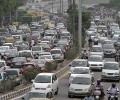
Dealers say that the full-year outlook remains negative with a projected contraction in retail sales of 15-35 per cent across segments, save tractors, which look set to clock a positive annual growth.

The current up move, according to analysts, closely resembles the rally post the global financial crisis in 2008-09, not just in quantum and speed, but also the way small-and mid-cap indices outperformed large-cap peers.

Indian economy is likely to rebound with an 8.9 per cent growth in the fiscal year beginning April 2021 after economic activity showed significant improvement in the last quarter, IHS Markit said on Friday. The National Statistical Organisation (NSO) on Thursday predicted that the economy will contract 7.7 per cent in the current financial year ending in March, the worst performance in four decades.

A majority of the CEOs are expecting the economy to show growth in the next financial year on the back of rising consumer spending and a sharp turnaround in rural India.

According to research firm IDC, a slowdown in smartphone shipments began showing up as early as late February, though companies insist that the March quarter was fine, albeit on a low base.

Assocham said even if an investment revival were to happen, it would be a time lag of at least 18 months before it reflects in the manufacturing sector.

The acquisition will give the Tatas a firm footing on international routes and generate economies of scale.

Starting with the third quarter of financial year 2020-21 (Q3FY21), we have seen "unlock" trades at various times. Whenever lockdowns have been eased, traders have taken long positions in consumer-facing businesses. Let's look at the logic. Since March 2020, sectors like retail, personal vehicles, hospitality, aviation, fast-moving consumer goods (FMCG), multiplexes, etc., have been under severe pressure. As a result, there's been a low base effect. Every company in these spaces has suffered top line contraction. Many suffered losses, especially in the first half of FY21.

'Today, 25 years later, Raja Hindustani is as much a Dharmesh Darshan film as it is Aamir Khan and Karisma Kapoor's 'different' love story.'

'Is China's intention not clear?' 'Do we still think that if we are nice to China, it will be good to us?'

Through the IPO, Burger King has raised Rs 450 crore, which will be used to rollout new outlets and retire debt.
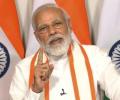
Last month, Prime Minister Narendra Modi had said that the economy is showing "green shoots" as the country emerges from the coronavirus lockdown and underscored the importance of being focussed on both life and livelihood.
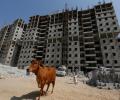
A host of dynamic reforms, policies and announcements during the last five years are expected to reach its logical fruition in the second term, says Ankit Kansal.

'By the time the goods that were sent from December onwards reached stores in Europe, they became dead inventory as the stores there were closed by then.' 'Those that were in the warehouse there also became dead inventory. Those that reached the ports there also became dead inventory.' 'And what Tirupur produced in March is still here, and they have also become dead inventory.'

Nirmala Sitharaman's maiden Budget has not disappointed but vision and details, particularly for the revival of agriculture, are missing.

'These are only passing clouds. The banking industry is a century-old industry and this is not the first time it is going through such a crisis.' 'When the economy revives, those companies that are in the infrastructure fields will also get revived.' 'After all, a lot of money has gone into creating assets like power projects and roads, so you can't say money has been wasted.'

A little over a year after it retained power in Kerala with a massive victory, the CPI-M-led Left Democratic Front suffered a huge setback on Friday in a bypoll held to Thrikkakara assembly constituency, with Congress candidate Uma Thomas winning with a historic margin of 25,016 votes, giving a boost to the morale of the party-led United Democratic Front in the southern state.

With supply of mobile chipsets running dry, manufacturers here are left with no option but to hike prices once again, making it the fourth round of increase in 2020.

Krishna chants gained more currency when Samajwadi Party chief Akhilesh Yadav invoked the deity.

The traffic tells a story. During the lockdown, it took 45 minutes to zip through the deserted 35-km stretch from Chennai to reach the automobile heart of Sriperumbudur-Oragadam, where the big names of the car industry - Hyundai Motor India, Renault-Nissan India, Daimler India Commercial Vehicles, Apollo Tyres, and Royal Enfield - are based.

Services companies reported an increase in new work intakes, which they attributed to successful marketing efforts and strengthening demand.

Single-screen cinema halls are likely to be allowed with strict social distancing norms.

'In the short term, we may see some disruptions due to Covid, but in the medium-to-long term, we should keep an eye on US inflation and 10-year bond yields.'

As India emerges from the COVID-19 crisis, the ninth budget under the Modi government, including an interim one, is widely expected to focus on boosting spending on job creation and rural development, generous allocations for development schemes, putting more money in the hands of the average taxpayer and easing rules to attract foreign investments.

TimesJobs.com's employment index -- The RecruiteX -- recorded 14 per cent increase in September 2014 over August 2014 with the IT/Telecom industry witnessing a 20 per cent increase in employment opportunities in just one month.

'Slowing down of the economy was mainly due to the demonetisation shock...' 'If you cut off the oxygen supply to a patient in the ICU and the patient dies, the patient does not come alive again when you restore the oxygen supply.'

Barring rice, spices, iron ore and pharmaceuticals, all the remaining 26 key sectors registered negative growth in May. Imports too plunged 51 per cent to $22.2 billion in May.

Portfolio returns, say analysts at Morgan Stanley, are more likely to be driven by bottom-up stock-picking rather than top-down macro forces.
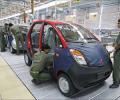
Expressing disappointment over the contraction in industrial growth in October, India Inc has appealed to the Reserve Bank to cut interest rates to revive the manufacturing sector and ameliorate investments.

The month of March could be worst in many years, with imports estimated only around 18 tonnes amid the coronavirus pandemic and the nationwide lockdown, said an industry player. The import in March 2019 was 72.5 tonnes, according to the GFMS data.
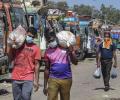
It is likely the government will divide the country into different zones during the proposed extended period of lockdown and might permit a few services to function in safe zones.

The retail inflation rate breached the 6 per cent upper tolerance limit of the RBI for the first time in seven months in January, while the wholesale price index stayed in double-digits for the 10th month in a row, showed two sets of data released by the government on Monday. Retail inflation, the key input for the RBI while reviewing the repo rate every two months, soared during the month mainly because of a spike in certain food items. The previous high for retail inflation was 6.26 per cent in June 2021.

Many weekly indicators turn positive as economy prepares for Unlock 3.0.

But their trajectory and direction have been largely influenced by politics and the political leadership's understanding of how the economy needs to be managed, explains A K Bhattacharya.

Gaurang Shah has been making a strong case for the good ol' sari.

Axis Bank was the top gainer in the Sensex pack, surging around 7 per cent, followed by Ultratech Cement, L&T, ICICI Bank, SBI, M&M and Bajaj Finance. On the other hand, Nestle India, Sun Pharma, Bharti Airtel and HUL ended in the red.

The muted expectation of dealers come at a time when vehicle manufacturers such as Maruti Suzuki, Hyundai Motor, Mahindra & Mahindra and others reported a double-digit fall in wholesale dispatches to dealerships in July and August.
